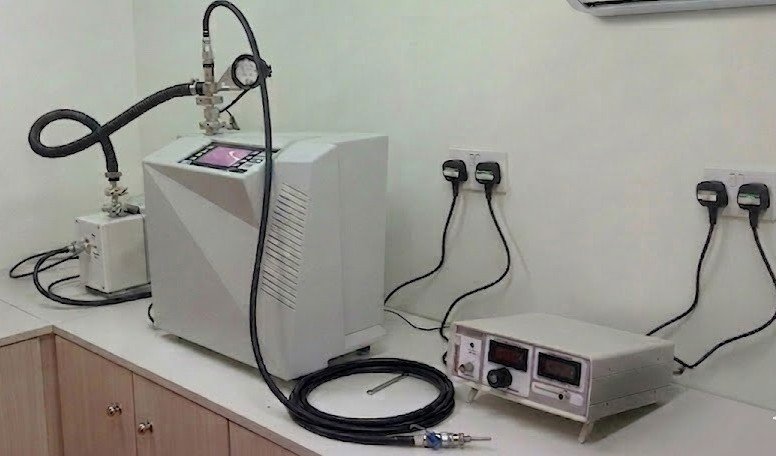
Helium leak testing
Helium leak testing is an ultra-sensitive integrity verification method that uses helium as a tracer gas to detect extremely small leaks in pipelines and process equipment. In this method, the system is first pressurized using a test gas mixture consisting of approximately 99% nitrogen and 1% helium to the specified test pressure. The helium-containing tracer gas is then monitored using a mass spectrometer–based leak detector capable of identifying extremely low leak rates. These systems can measure leak rates below 1 SCF/year, corresponding to sensitivities as low as 10⁻¹² mbar·L/s.
This high sensitivity makes helium leak testing particularly valuable for high-integrity gas systems, LNG and cryogenic equipment, and applications requiring stringent leak-tightness assurance.
Helium is preferred as a tracer gas because its dynamic viscosity (~1.96 × 10⁻⁵ Pa·s) is comparable to that of methane (~1.1 × 10⁻⁵ Pa·s), it is chemically inert, and it has an extremely low natural background concentration. These properties make helium ideal for the precise detection of viscous leaks